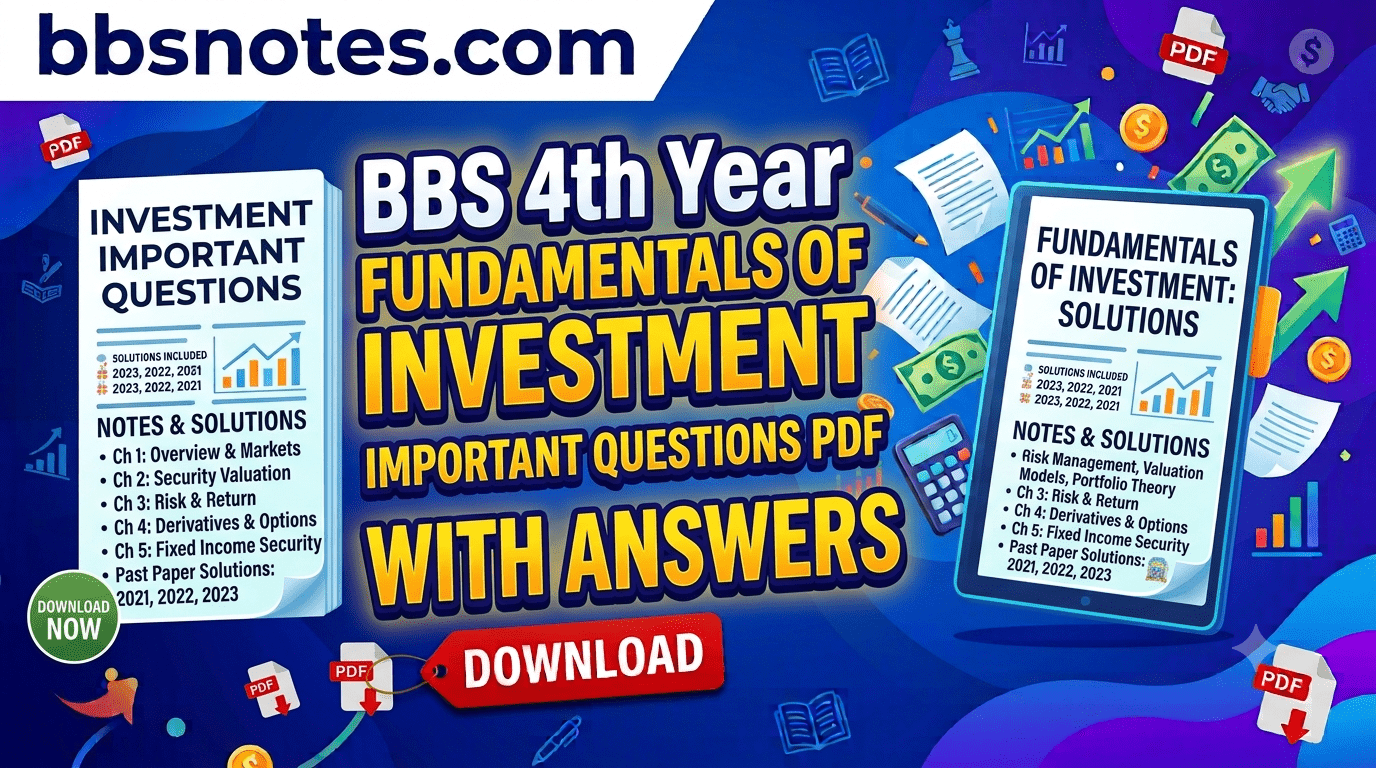
We have the BBS 4th Year Fundamentals of Investment Important Questions PDF. If you are a finance group student in the BBS fourth year than it will be useful for you and your friends for preparation.
BBS 4th Year Fundamentals of Investment Important Questions PDF
Following are the BBS 4th Year Fundamentals of Investment Important Questions PDF.
2 Marks Questions
2079
1. What do you mean by investment plan?
2. List out the uses of market index.
3. Write the role of primary market.
4. Differentiate between market order and limit order.
5. Calculate the yield on a investment with Rs. 10,000 today that promises to payback Rs. 15,000 at the end of 5 years? Is this investment a good if your required rate of return is 9 percent?
Also Read: BBS 4th Year Old is Gold Pdf.
6. A stock paid Rs. 40 dividend last year. The dividend is expected to grow at 6 percent rate for foreseeable future. If stock’s current selling price is Rs. 500, what is the expected return on this stock?
7. A stock has a beta of 1.8 the expected return on the market is 15 percent, and the risk-free rate is 5 percent. What must the expected return on this stock be? If return on stock is 20 percent would you purchase the stock?
8. How do you interpret a portfolio with Jensen’s Alpha of 1.2 percent?
9. What is the value of a put option written on a share if its strike price is Rs 1.60 and market price of a share is Rs. 140?
10. If you hold a call option, in what situation do you exercise it?
Also Read: BBS 4th Year Fundamentals of Investment 2080 Questions Paper.
2080
1. Distinguish between investment and speculation.
2. Who is an issue manager? List any three functions of issue manager.
3. What is long purchase? Illustrate with an example.
4. What is the expected return on a stock with a beta of 1.15 a market risk premium of 6 percent and a risk free return of 5 percent? Distinguish between cash dividend and stock dividend.
5. Assume a share of stock is selling at Rs. 200 per share. You buy 100 shares of stock on margin today. If the initial margin is 60 percent and maintenance margin is 40 percent, compute the margin call price.
6. A well-known company has total assets of Rs. 400 million, total debt of Rs. 160 million, and Rs. 40 million of 10 percent preferred stock outstanding. If the company has 10,00,000 shares of common stock outstanding, what is the book value per share?
7. Explain why bank discount yield is lower than bond equivalent yield.
8. A bond has a Macaulay duration equal to 6 years and a yield to maturity of 9 percent. What is the percentage change in price of a bond if yield to maturity rises to 9.5 percent?
10. Write the meaning of derivative securities.
2081
1. State four money market vehicles.
2. Suppose you have a call option of Rs. 25 premium to buy share of Delta Company (DC) at Rs. 350 per share. Calculate value of call option (pay-off) and profits if the market price of Delta stock rises to Rs. 400 per share.
3. Assume that the risk-free rate is 6 percent and the market risk premium is 5 percent. What is the required rate of return on stock X with its beta of 1.30? Would you like to sell the stock X if its expected rate of return is 10 percent?
4. State major sources of risk.
5. Differentiate between open-end and closed-end funds.
6. What is the technical analysis of financial securities?
7. What are the major sources of investment information?
8. Write the meaning of fixed income securities.
9. What is term structure of interest rates?
10. Assume current market price of stock Y is Rs. 175, and constant growth rate is 10 percent. One convertible bond of Company Y can be converted into its 5 common stocks, what is the conversion value of the convertible present?
10 or 15 Marks Questions
1. What do you mean by an option? What are the main attractions of call and put options?
2. Describe the investment Processes for financial assets in Nepal
Also Read: BBS 4th Year Old Questions Paper PDF
3. What is an investment? Explain the different types of investment.
4. Describe the major types of investment vehicles. Which of these investment vehicles are most common in the Nepalese financial market? (10–15)
5. Describe the status/present situation of the investment environment in Nepal. (10)
6. What does a comprehensive investment plan consist of? What are the systematic steps involved in investing? How do the considerations about taxes, the life cycle of investor and different economic environments affect investment?
Also Read: TU BBS 4th year Syllabus & subjects.
7. What do you mean by an investment banker? Describe the roles of investment bankers in the securities offering process. (15)
More Important Questions
8. Highlights the different types of securities markets. Describe the role of the Security Board of Nepal in regulating these markets.
9. Explain why investors prefer to hold a diversified portfolio of securities. Also, explain the contribution of Markowitz model on it.
10. Distinguish between technical and fundamental analysis? Explain why technical analysis is important in making investment decision.
11. What is fixed income securities? Describe the major types of fixed-income securities. (10–15)
Also Read:BBS 4th Year all subjects Notes.
12. What is a mutual fund? Explain in brief the development of mutual funds in Nepal. (10) (Advantage/Disadvantage & open end-close end)
13. How does the price of underlying assets affect the value of call and put? Explain.
Hence, these are the BBS 4th Year Fundamentals of Investment Important Questions PDF.
Other Important Link
a. BBS 4th Year Proposal Sample PDF
b. BBS 4th-year project report pdf
| Chapters | Name of the Chapters | Important Questions |
|---|---|---|
| 1 | The Investment Environment | CLICK HERE |
| 2 | Securities Markets | CLICK HERE |
| 3 | Investment Information and Securities Transactions | CLICK HERE |
| 4 | Risk, Return and Portfolio Management | CLICK HERE |
| 5 | Common Stock Fundamentals | CLICK HERE |
| 6 | Common Stock Analysis and Valuation | CLICK HERE |
| 7 | Fixed Income Securities | CLICK HERE |
| 8 | Bond Valuation | CLICK HERE |
| 9 | Mutual Fund and Performance Evaluation | CLICK HERE |
| 10 | Managing Portfolios | CLICK HERE |
| 11 | Derivative Securities | CLICK HERE |
| All Chapter 2 Marks Questions with Answers | CLICK HERE |