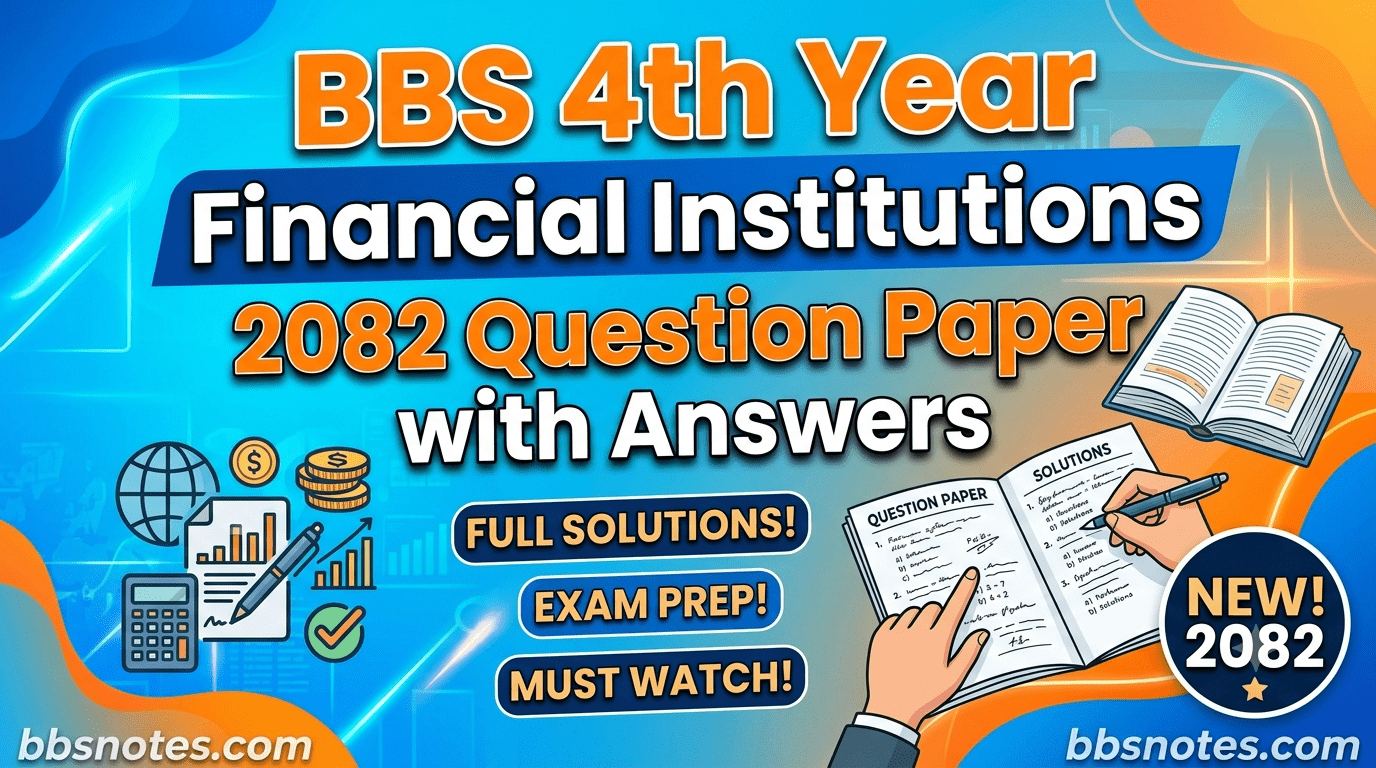
We have the BBS 4th Year Financial Institutions 2082 Questions Paper with Answers. If you are a BBS 4th year students than you can prepare for your exam with these past Questions.
BBS 4th Year Financial Institutions 2082 Questions Paper
Following are the BBS 4th Year Financial Institutions 2082 Questions Paper.
TRIBHUVAN UNIVERSITY — 2082 B.B.S. 4 Yrs. Prog. / IV Year / MGMT
Management of Financial Institutions (FIN 255) Group “A” Brief Answer Questions (Attempt ALL questions)
1. Write the meaning of financial markets.
2. What do you mean by the expectation theory of interest rate?
Also Read: BBS 4th Year Old Questions Paper PDF
3. Write down open market operations tools used by Nepal Rastra Bank.
4. What are the two major liabilities of the commercial banks?
5. State the meaning of group lending.
6. What do you mean by cooperatives?
Also Read: BBS 4th Year Fundamentals of Investment Notes.
7. Write the types of insurance business in Nepal.
8. The real risk-free rate is $2\%$. Inflation is expected to be 2% this year and 4% during the next 2 years. Assume that the maturity risk premium is zero. What is the yield on 2-year Treasury securities?
9. An investor purchases a mutual fund share for Rs 200. The fund pays dividends of Rs 4, distributes a capital gain of Rs 5, and charges a fee of Rs 3 when the fund is sold one year later for Rs 210. What is the net rate of return from this investment?
Also Read: TU BBS 4th year Syllabus & subjects.
10. The current one-year Treasury bill rate is 5 percent, and the expected one-year rate one year from now is 6 percent. According to the unbiased expectations theory, what should be the current rate for a two-year Treasury security?
Group “B” Descriptive Answer Questions
(Attempt any FIVE questions) [5 * 10 = 50]
11. Explain the concept and key principles of microfinance.
12. Explain the rationale of growing cooperatives in Nepal.
Also Read: BBS 4th Year Old is Gold Pdf.
13. Suppose you deposit Rs 15,000 annually into a provident fund for the next 10 years, after which time you plan to retire.
a. If the deposits are made at the beginning of the year and earn an interest rate of 10 percent, what will be the amount of retirement funds at the end of year 10?
b. Instead of a lump sum, you want to receive annuities for the next 20 years (years 11 through 30). What is the constant annual payment you expect to receive at the beginning of each year if you assume an interest rate of 10 percent during the distribution period?
c. What implications do you find from the above calculations to derive benefits from the provident fund? Explain.
Also Read: BBS 4th Year Fundamentals of Investment Important Questions PDF.
Group “C” Analytical Answer Questions (Attempt any TWO questions) [2* 15 = 30]
17. An investment banker is the middleman between the issuing company and investors. In this connection, briefly explain the functions performed by the investment bankers in the Nepalese capital market.
19. Suppose the banking system has total deposits of Rs 1,000 billion. Nepal Rastra Bank’s required reserve ratio is 4% and Nepal Rastra Bank has announced that the reserve ratio is increased by 1 percent to control the liquidity in the banking system.
a. What will be the required reserves before increasing the reserve ratio?
b. What will be the required reserves after increasing the reserve ratio?
c. What will be the size of reserves after an increase in the reserve ratio?
d. What will be the money multiplier before and after the increase in the reserve?
e. Calculate the maximum amount of contraction of the money supply in the banking system?
Hence, these are the BBS 4th Year Financial Institutions 2082 Questions Paper.